
Extractables & Leachables
Testing in 2026:
The Compliance Gap
Most Companies Miss
For many manufacturers, E&L testing is no longer simply a regulatory checkbox. It has become a strategic requirement directly linked to patient safety, product quality, market approvals, and brand protection.
As pharmaceutical and medical device regulations continue to evolve in 2026, Extractables and Leachables (E&L) testing has become one of the most critical components of product safety and regulatory compliance. Regulatory agencies worldwide are now placing greater emphasis on understanding how packaging materials, manufacturing components, and delivery systems interact with pharmaceutical products throughout their lifecycle.
For many manufacturers, E&L testing is no longer simply a regulatory checkbox. It has become a strategic requirement directly linked to patient safety, product quality, market approvals, and brand protection.
Despite growing regulatory scrutiny, many companies still underestimate the complexity of E&L studies. Incomplete extraction strategies, weak toxicological assessments, and insufficient analytical sensitivity often create major compliance gaps that may lead to delayed approvals, regulatory observations, product recalls, and patient safety risks.
At Accuprec Research Labs Pvt. Ltd., we help pharmaceutical and medical device manufacturers develop scientifically robust Extractables and Leachables programs aligned with global regulatory expectations and modern risk-based compliance strategies.
Understanding Extractables & Leachables
What Are Extractables?
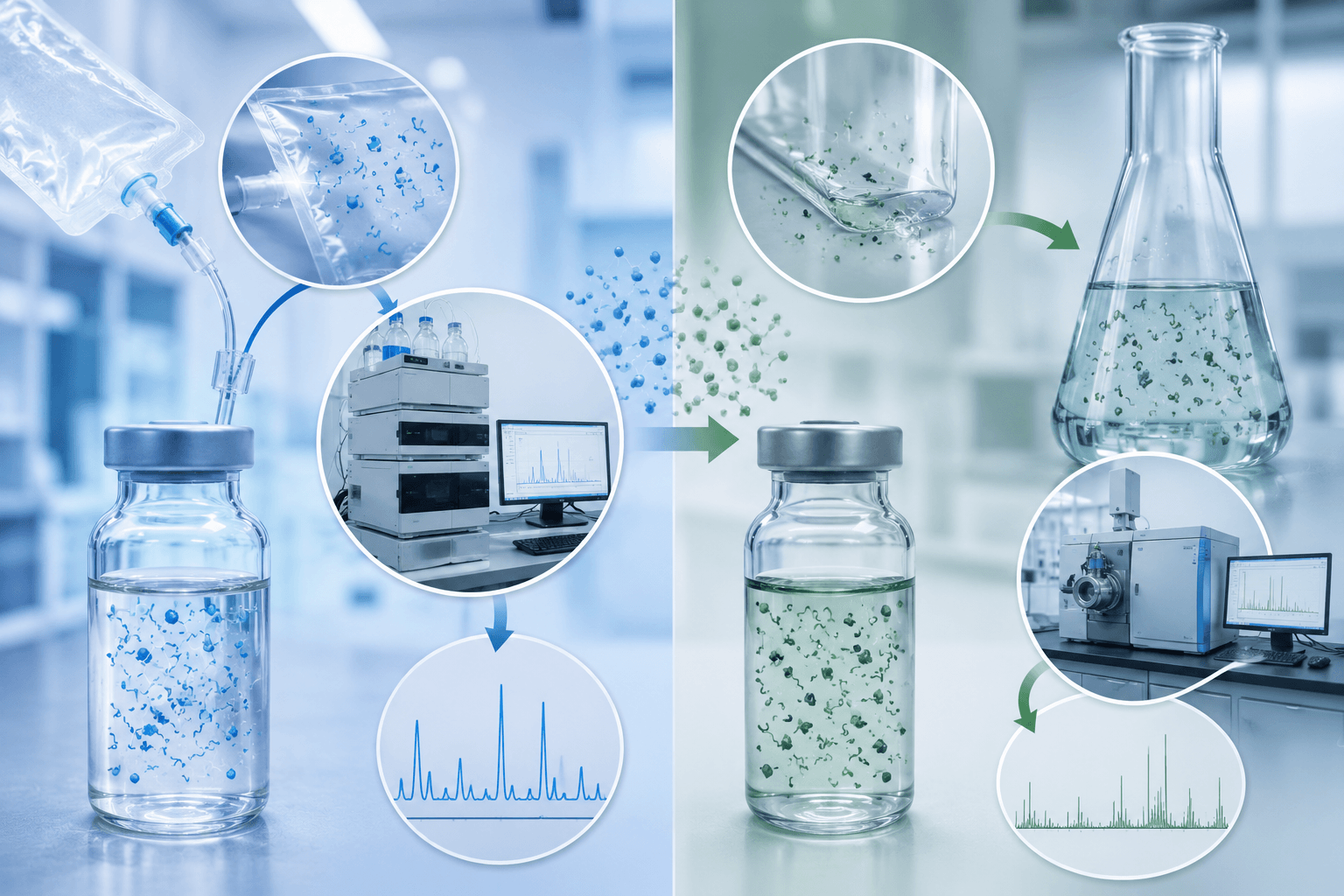
Extractables are chemical compounds that can be released from packaging systems, manufacturing components, or device materials under aggressive laboratory extraction conditions.
What Are Leachables?
Leachables are compounds that actually migrate into the pharmaceutical product or medical device formulation during normal storage and usage conditions.
These compounds may originate from:
- Plastic packaging materials
- Rubber closures
- Tubing systems
- Syringes
- Manufacturing equipment
- Single-use systems
- Container closure systems
- Processing materials
Even trace-level chemical migration may impact product quality, stability, efficacy, and patient safety. As pharmaceutical products become more complex and biologics continue to expand globally, regulators increasingly expect manufacturers to thoroughly evaluate E&L risks across the entire product lifecycle.
Why E&L Testing Matters More in 2026
Modern drug products and medical devices often involve highly sensitive formulations that may interact with packaging and delivery systems over extended periods. Without proper E&L assessment, manufacturers risk:
- Product contamination
- Toxicological exposure
- Stability failures
- Regulatory non-compliance
- Patient safety concerns
- Product recalls
- Import alerts
- Market reputation damage
Regulatory agencies now expect companies to demonstrate scientific understanding of potential chemical migration risks and establish appropriate control strategies supported by analytical evidence.
The Compliance Gap Most Companies Miss
One of the biggest industry challenges is assuming that limited screening studies or basic risk assessments are sufficient for regulatory compliance. In reality, many E&L programs fail because they lack a comprehensive scientific approach.
Common compliance gaps include:
Incomplete Extraction Strategies
Poorly designed extraction studies may fail to simulate worst-case conditions or overlook critical material interactions. Without comprehensive extraction design, manufacturers may miss potentially harmful compounds.
Inadequate Analytical Methods
Low-sensitivity analytical techniques often fail to detect trace-level compounds that may still present toxicological concerns. Modern E&L programs require highly sensitive analytical platforms capable of identifying unknown compounds at extremely low concentrations.
Weak Toxicological Assessment
Analytical detection alone is not enough. Companies must also determine whether detected compounds pose actual patient safety risks. Weak toxicological justification is one of the most common reasons regulators challenge E&L submissions.
Poor Risk Assessment Methodology
Risk assessments must be scientifically justified, product-specific, and supported by analytical evidence. Generic or template-based evaluations often fail during regulatory review.
Regulatory Documentation Deficiencies
Incomplete reporting, missing scientific rationale, and weak study interpretation frequently create compliance challenges during inspections and product submissions.
Despite growing regulatory scrutiny, many companies still underestimate the complexity of E&L studies. Incomplete extraction strategies, weak toxicological assessments, and insufficient analytical sensitivity often create major compliance gaps.
Regulatory Expectations Are Increasing
Global health authorities, including the FDA, EMA, USP, and ISO standards organizations, now expect manufacturers to implement scientifically robust E&L strategies aligned with modern risk-based quality systems. Authorities are also placing greater focus on data integrity, reproducibility, and lifecycle risk management.
Regulators increasingly evaluate:
- Extraction study design
- Worst-case simulation approaches
- Analytical sensitivity
- Unknown compound identification
- Toxicological qualification
- Safety thresholds
- Risk-based decision making
- Documentation quality
The Importance of Advanced Analytical Technologies
Modern Extractables and Leachables studies require advanced analytical capabilities capable of identifying both known and unknown compounds at trace levels.
Commonly Used Analytical Techniques:
- GC-MS
- LC-MS/MS
- ICP-MS
- Headspace GC
- HRMS analysis
These Technologies Support:
- Trace-level detection
- Structural characterization
- Unknown compound identification
- Quantitative analysis
- Toxicological assessment support
High-resolution analytical capability is essential for generating regulator-ready E&L data.
A Risk-Based, Toxicology-Led Approach
Regulatory agencies now expect E&L studies to be integrated into broader risk management frameworks. This toxicology-led approach helps manufacturers prioritize compounds based on actual patient exposure risk rather than simply generating large volumes of analytical data.
An effective E&L strategy should include:
Product-Specific Risk Assessment
Scientifically justified, product-specific evaluation supported by material characterization and analytical evidence.
Worst-Case Extraction Design
Comprehensive extraction strategies designed to simulate worst-case conditions and capture all potential migrants.
Toxicological Evaluation & Safety Thresholds
Assessment of detected compounds against patient safety thresholds with scientifically justified qualification decisions.
Ongoing Lifecycle Monitoring
Continuous evaluation throughout the product lifecycle to detect changes in leachable profiles over time.
Common Industries Requiring E&L Testing
Extractables and Leachables studies are increasingly important across multiple regulated industries. Products involving long-term storage or sensitive formulations require particularly detailed E&L evaluation.
Injectable pharmaceuticals
Biologics
Ophthalmic products
Inhalation products
Combination products
Medical devices
Drug delivery systems
Single-use bioprocessing systems
Comprehensive E&L Support at Accuprec
At Accuprec Research Labs Pvt. Ltd., we provide end-to-end Extractables and Leachables testing solutions designed to support regulatory submissions, product safety, and lifecycle compliance. Our laboratories operate with advanced analytical infrastructure, experienced scientific professionals, and quality-focused systems to ensure reliable and reproducible results.
Our capabilities include:
- Controlled extraction studies
- Leachables profiling
- Unknown compound identification
- GC-MS analysis
- LC-MS/MS analysis
- ICP-MS elemental assessment
- Toxicological risk evaluation
- Method development and validation
- Regulatory documentation support
Building Regulatory Confidence Through Scientific Excellence
In 2026, regulators increasingly expect manufacturers to demonstrate proactive chemical risk management rather than reactive problem-solving. At Accuprec, our scientific experts work closely with manufacturers to design customized E&L strategies aligned with global regulatory expectations and product-specific requirements.
A scientifically designed E&L program helps companies:
- Improve patient safety
- Reduce product recalls
- Strengthen global compliance
- Accelerate market approvals
- Minimize regulatory deficiencies
- Build long-term brand trust
From Compliance Gap to Regulatory Confidence
Extractables and Leachables testing has become one of the most important regulatory and scientific requirements in the pharmaceutical and medical device industries. As global compliance expectations continue to evolve, companies can no longer rely on incomplete extraction studies or weak risk assessments.
Manufacturers that adopt comprehensive, toxicology-led, and analytically robust E&L strategies are better positioned to protect patients, ensure compliance, and achieve long-term regulatory success.
With advanced analytical capabilities, experienced scientific teams, and regulator-focused execution, Accuprec Research Labs Pvt. Ltd. helps manufacturers confidently navigate complex Extractables and Leachables challenges from start to finish.
Partner with Accuprec Research Labs Pvt. Ltd. for comprehensive Extractables & Leachables testing and regulatory support.