
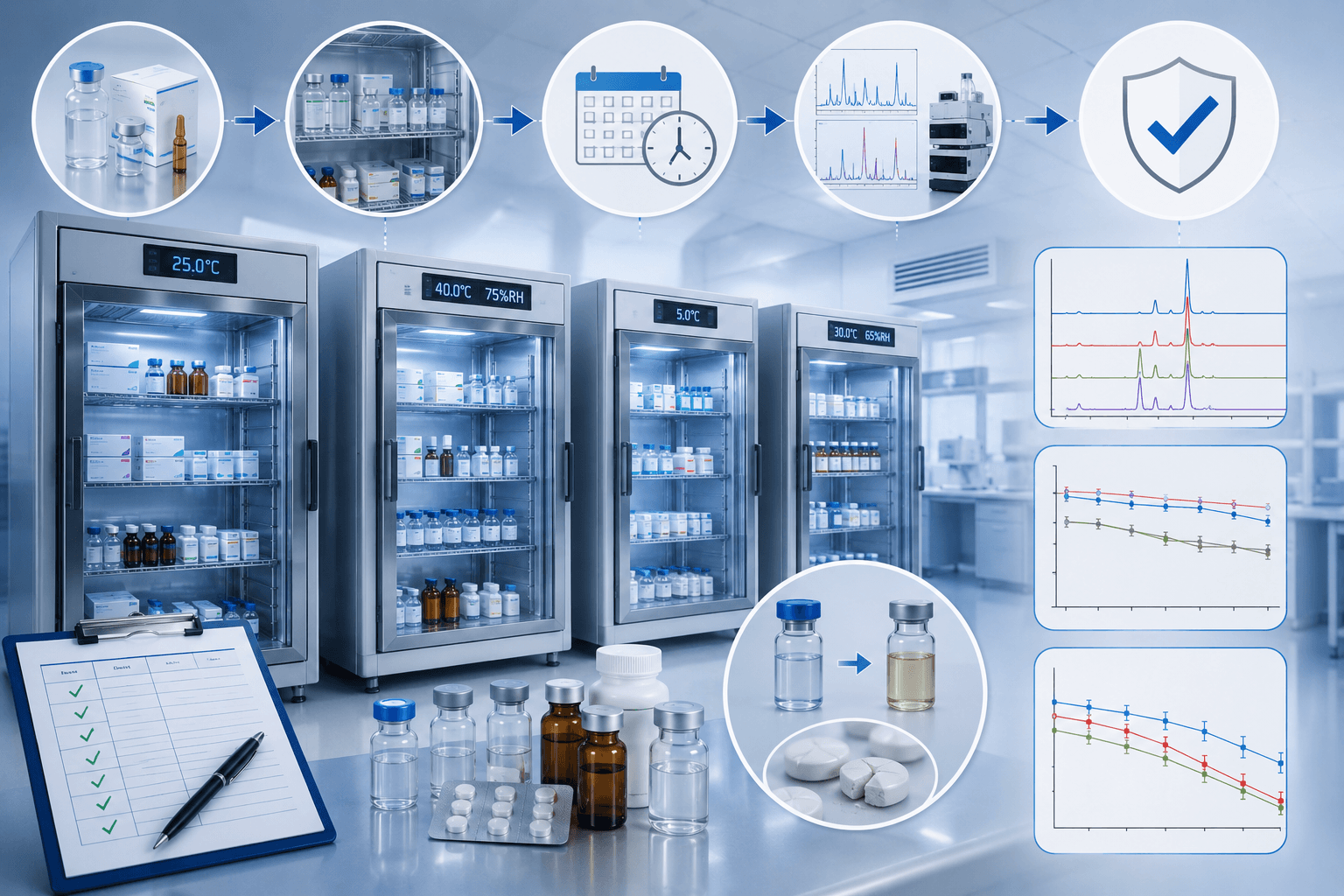

Stability Testing in 2026: ICH Q1 Compliance, Real-Time vs. Accelerated Studies
Stability testing is no longer a routine compliance activity — it is a critical pillar of pharmaceutical quality assurance that directly influences product approvals, lifecycle management, and market reliability.
The pharmaceutical industry in 2026 is operating in an increasingly complex regulatory environment where product quality, shelf-life accuracy, and data integrity are under constant scrutiny. As global health authorities strengthen expectations around pharmaceutical stability programs, manufacturers are under pressure to generate scientifically robust stability data that supports both product safety and long-term efficacy.
Stability testing is no longer viewed as a routine compliance activity. Regulatory agencies now consider stability studies a critical component of pharmaceutical quality systems, directly influencing product approvals, lifecycle management, and market reliability.
Under ICH Q1 guidelines, companies are expected to establish scientifically designed stability programs capable of demonstrating how pharmaceutical products maintain their identity, strength, quality, and purity throughout their intended shelf life.
At Accuprec Research Labs Pvt. Ltd., we help pharmaceutical manufacturers design and execute comprehensive stability programs aligned with ICH expectations, global regulatory standards, and real-world storage conditions.
Why Stability Testing Has Become More Important Than Ever
Pharmaceutical products are highly sensitive to environmental conditions such as temperature, humidity, light exposure, and packaging interactions. Even minor changes in storage conditions can affect product quality, potency, dissolution, degradation profiles, and patient safety.
Regulatory authorities require manufacturers to prove that products remain stable throughout distribution, storage, and patient use. Without reliable stability data, companies risk:
- Regulatory observations
- Product recalls
- Market complaints
- Shelf-life failures
- Import alerts
- Delayed approvals
- Brand reputation damage
In today’s regulatory landscape, stability testing is directly connected to risk management, product quality assurance, and regulatory confidence.
Understanding ICH Q1 Stability Guidelines
ICH Q1 guidelines provide the global framework for pharmaceutical stability testing. These guidelines define how stability studies should be designed, conducted, interpreted, and documented for regulatory submissions. Regulators expect manufacturers to develop stability programs that are scientifically justified, reproducible, and representative of actual storage conditions.
ICH Q1 covers several important areas, including:
- Long-term stability studies
- Accelerated stability studies
- Intermediate storage conditions
- Stress testing
- Photostability studies
- Stability protocol design
- Shelf-life determination
- Data evaluation and trending
Real-Time vs. Accelerated Studies: Why Both Matter
Real-Time Stability Studies
Real-time stability testing evaluates products under recommended storage conditions over the intended shelf-life period.
Typical Long-Term Conditions:
- 25°C / 60% RH
- 30°C / 65% RH
- Region-specific climatic zone requirements
These Studies Provide:
- Actual shelf-life evidence
- Real-world product behavior
- Stronger long-term confidence
- Lower stress exposure
Accelerated Stability Studies
Accelerated studies expose products to elevated stress conditions to predict long-term stability behavior within shorter timelines.
Common Accelerated Conditions:
- 40°C / 75% RH
These Studies Provide:
- Faster preliminary insights
- Early degradation detection
- Development support
- Risk prediction capabilities
One of the biggest misconceptions in pharmaceutical development is assuming accelerated studies can fully replace long-term real-time testing. In reality, both studies serve different scientific and regulatory purposes. Regulators expect manufacturers to scientifically correlate both datasets while ensuring data integrity and appropriate extrapolation approaches.
What Regulators Scrutinize Most in 2026
Regulatory agencies worldwide have significantly increased scrutiny around stability programs, especially during GMP inspections and dossier reviews. Some of the most closely reviewed areas include:
Study Design & Scientific Justification
Authorities assess whether storage conditions, testing intervals, and analytical methods are scientifically justified for the product type and intended market.
Data Integrity & Trending
Inspectors carefully review raw data traceability, trend analysis, OOS investigations, electronic records, and statistical evaluation. Any inconsistency in data management may trigger serious compliance concerns.
Degradation Pathway Understanding
Regulators expect manufacturers to understand how products degrade under various environmental conditions and how degradation impacts patient safety.
Extrapolation Validity
Companies using accelerated data for shelf-life projections must provide strong scientific justification supporting extrapolation models. Weak extrapolation strategies often lead to regulatory deficiencies.
Risk Assessment & Control Strategies
Modern stability programs are expected to integrate quality risk management principles, including product-specific risk analysis, packaging evaluation, transportation risk assessment, and environmental monitoring strategies.
Common Stability Testing Challenges
Many manufacturers continue to face difficulties in building globally compliant stability programs. Without proper scientific planning, stability studies can become costly, delayed, and vulnerable to regulatory observations.
- Inadequate protocol design
- Poor chamber qualification
- Inconsistent sampling plans
- Analytical variability
- Weak data trending
- Insufficient degradation studies
- Improper shelf-life justification
- Incomplete documentation
Advanced Stability Testing Support at Accuprec
At Accuprec Research Labs Pvt. Ltd., we provide comprehensive stability testing solutions designed to support pharmaceutical development, regulatory submissions, and lifecycle management. Our laboratories operate under strict quality systems with GLP-focused practices, ensuring accurate, reproducible, and regulator-ready data generation.
Our capabilities include:
- Real-time stability studies
- Accelerated stability testing
- Intermediate stability studies
- Photostability testing
- Forced degradation studies
- Method validation support
- Stability indicating method development
- Data trending and interpretation
- Regulatory documentation support
Building Regulatory Confidence Through Scientific Stability Programs
In 2026, stability testing is no longer only about generating data — it is about demonstrating scientific control, product understanding, and long-term quality assurance. At Accuprec, our scientific teams work closely with pharmaceutical companies to build customized stability strategies aligned with ICH Q1 expectations and global regulatory requirements.
Manufacturers that invest in scientifically designed stability programs are better positioned to:
Reduce Regulatory Risks
Scientifically justified stability programs minimize observations, deficiencies, and compliance issues during regulatory review.
Accelerate Approvals
Robust, well-documented stability data strengthens submissions and reduces regulatory back-and-forth.
Improve Product Reliability
Comprehensive testing ensures products perform consistently throughout their intended shelf life and distribution chain.
Strengthen Global Market Access
ICH Q1-aligned stability programs support multi-market submissions and regulatory acceptance worldwide.
Every Aspect of Stability Contributes to Regulatory Success
As regulatory expectations continue to evolve, stability testing has become one of the most critical pillars of pharmaceutical quality assurance. From real-time studies and accelerated testing to degradation analysis and shelf-life justification, every aspect of a stability program contributes to regulatory success and patient safety.
Companies that adopt scientifically robust, risk-based stability strategies will be better prepared to meet global compliance expectations and maintain long-term product quality.
With advanced infrastructure, experienced scientific professionals, and regulator-focused execution, Accuprec Research Labs Pvt. Ltd. supports pharmaceutical manufacturers with complete end-to-end stability testing solutions.