
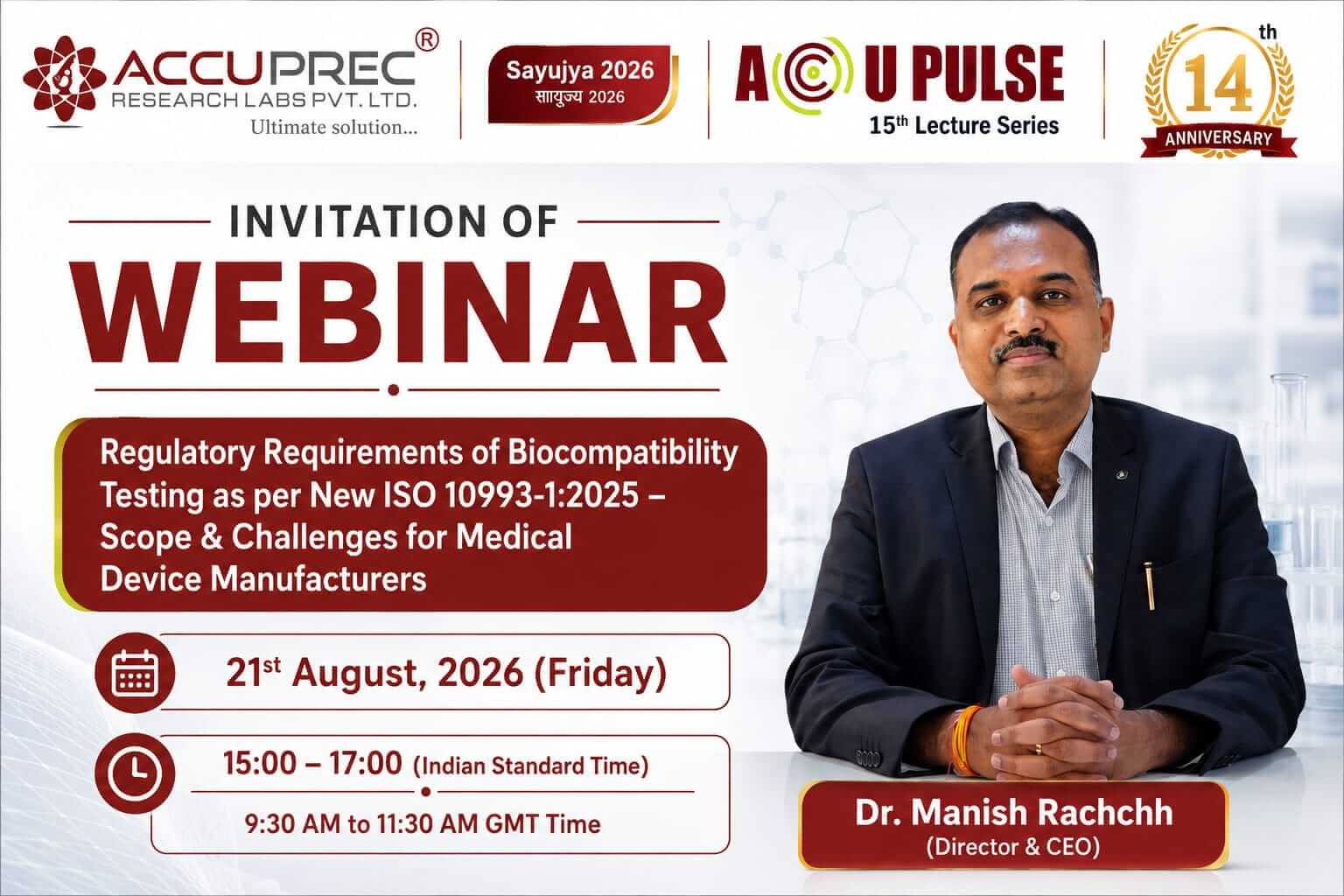

Webinar: ISO 10993-1:2025 –
Regulatory Requirements,
Scope & Challenges for
Medical Device Manufacturers
Understanding the New Biocompatibility Requirements for Medical Devices
Biocompatibility is a critical part of medical device safety and regulatory compliance. Every medical device that comes into contact with the human body must be evaluated to determine whether it can cause adverse biological reactions during its intended use.
With the introduction of ISO 10993-1:2025, medical device manufacturers need to take a closer look at how biological evaluation is planned, documented, and justified. The updated standard brings greater emphasis on a structured, risk-based approach to biological evaluation, making it essential for manufacturers to understand the scope, regulatory expectations, and practical challenges associated with biocompatibility testing.
To help manufacturers and regulatory professionals understand these developments, Accuprec Research Labs Pvt. Ltd. is hosting a webinar focused on the “Regulatory Requirements of Biocompatibility Testing as per New ISO 10993-1:2025 – Scope & Challenges for Medical Device Manufacturers.”
What Does ISO 10993-1:2025 Mean for Medical Device Manufacturers?
ISO 10993-1 provides a framework for evaluating the biological safety of medical devices based on their nature, duration, and type of contact with the human body.
The 2025 edition reinforces the importance of considering the complete biological evaluation process rather than treating individual biocompatibility tests as isolated regulatory requirements. Manufacturers are expected to understand the device, its materials, manufacturing processes, intended use, contact characteristics, and potential biological risks before determining the appropriate evaluation strategy.
This approach can help manufacturers avoid unnecessary testing while ensuring that relevant biological risks are adequately addressed.
Why Is a Risk-Based Approach Important?
A comprehensive biological evaluation begins with identifying potential biological hazards associated with a medical device.
Factors such as:
- Nature and duration of patient contact
- Contact with skin, blood, tissue, or other body compartments
- Material composition
- Manufacturing processes
- Chemical characterization
- Existing toxicological information
- Potential degradation products
- Clinical history and previous use
can influence the overall biological evaluation strategy.
Rather than automatically conducting every available biocompatibility test, manufacturers need to establish a scientific and risk-based rationale for selecting appropriate endpoints.
Key Challenges for Medical Device Manufacturers
The transition toward updated regulatory expectations can create several challenges for manufacturers.
Understanding Applicable Biological Endpoints
Determining which biological endpoints are relevant to a particular device can be complex. Manufacturers must consider the device’s characteristics and intended clinical application when developing the evaluation plan.
Generating Adequate Scientific Justification
Regulatory submissions require clear documentation explaining why specific tests were conducted—or why certain tests were not considered necessary. A scientifically sound justification is therefore an important component of the biological evaluation process.
Chemical Characterization and Toxicological Assessment
For many devices, understanding the chemicals that may be present or released from materials is an important part of assessing biological risk. Chemical characterization and toxicological evaluation can provide valuable information for determining potential patient exposure and associated risks.
Maintaining Regulatory Compliance
Medical device manufacturers operating across different markets may need to meet multiple regulatory expectations. Aligning testing strategies and documentation with applicable standards can help reduce delays during regulatory review.
Building an Effective Biocompatibility Testing Strategy
An effective strategy should begin early in the medical device development process. Instead of considering biocompatibility testing only before regulatory submission, manufacturers should integrate biological evaluation into product development and risk management activities.
Working with an experienced testing and research partner can help manufacturers identify appropriate biological endpoints, develop suitable testing strategies, interpret results, and prepare scientifically justified documentation.
At Accuprec Research Labs Pvt. Ltd., specialized testing capabilities support medical device manufacturers in addressing their biological safety and regulatory requirements through a structured scientific approach.
Join the Accuprec Webinar
To provide deeper insights into the updated requirements and practical challenges associated with ISO 10993-1:2025, Accuprec Research Labs is organizing a dedicated webinar featuring Dr. Manish Rachchh, Director & CEO.
The session is designed to help medical device manufacturers, regulatory professionals, quality teams, researchers, and other industry professionals gain a better understanding of the evolving requirements surrounding biocompatibility evaluation.
Participants can register by scanning the QR code provided in the webinar invitation or using the registration link shared by Accuprec Research Labs.
An E-certificate will be issued to participants after completion of the webinar, followed by successful completion of the online quiz.
Conclusion
The updated ISO 10993-1:2025 framework highlights the importance of a scientifically justified and risk-based approach to biological evaluation. For medical device manufacturers, understanding these expectations early can support better testing decisions, stronger regulatory documentation, and more efficient product development.
As regulatory expectations continue to evolve, staying informed about the latest requirements is essential for maintaining compliance and ensuring patient safety.
Join Accuprec Research Labs for this insightful webinar and strengthen your understanding of biocompatibility testing under ISO 10993-1:2025.
Accuprec Research Labs Pvt. Ltd.