

Elemental Impurities
Under ICH Q3D: Why
Your Risk Assessment
May Not Be Enough
Regulatory agencies now expect pharmaceutical manufacturers to move beyond theoretical risk assessments and demonstrate scientifically validated control strategies supported by actual analytical testing.
As pharmaceutical regulations continue to evolve in 2026, elemental impurity control has become one of the most closely monitored areas during global regulatory inspections and product evaluations. Regulatory agencies now expect pharmaceutical manufacturers to move beyond theoretical risk assessments and demonstrate scientifically validated control strategies supported by actual analytical testing.
Under ICH Q3D guidelines, manufacturers are required to assess and control elemental impurities that may arise from raw materials, catalysts, manufacturing equipment, packaging systems, or environmental contamination.
While many companies rely heavily on paper-based risk assessments, regulators increasingly recognize that risk assessments alone cannot always confirm actual impurity levels within pharmaceutical products.
At Accuprec Research Labs Pvt. Ltd., we help pharmaceutical manufacturers establish scientifically robust elemental impurity programs through advanced analytical testing, toxicological evaluation, and regulatory-focused compliance strategies.
Understanding Elemental Impurities in Pharmaceuticals
Elemental impurities are trace metal contaminants that may unintentionally enter pharmaceutical products during manufacturing or packaging processes. Certain elemental impurities can pose significant toxicological risks to patients, especially during chronic exposure.
These impurities may originate from:
- Raw materials
- Water systems
- Manufacturing equipment
- Catalysts
- Processing aids
- Container closure systems
- Environmental exposure
Because of these potential health risks, regulators worldwide now require manufacturers to establish effective impurity control strategies aligned with ICH Q3D guidelines.
What ICH Q3D Actually Requires
ICH Q3D provides a science- and risk-based framework for controlling elemental impurities in pharmaceutical products. However, regulatory compliance involves far more than simply performing a theoretical evaluation.
The guideline establishes:
- Permitted daily exposure (PDE) limits
- Element classification systems
- Toxicological thresholds
- Route-specific exposure limits
- Risk assessment expectations
The primary objective is to ensure that elemental impurities remain below levels that may compromise patient safety.
Why Risk Assessments Alone May Not Be Enough
Many pharmaceutical companies assume that performing a documented risk assessment is sufficient to satisfy regulatory expectations. In reality, regulators increasingly challenge risk assessments that lack supporting analytical evidence.
A risk assessment can help identify potential contamination sources, but it cannot always confirm:
- Actual impurity concentrations
- Batch-to-batch variability
- Unexpected contamination pathways
- Equipment-related leaching
- Supplier variability
- Process-induced contamination
Without analytical verification, companies may overlook hidden elemental impurity risks that become serious compliance concerns during inspections or regulatory review.
The Growing Importance of Analytical Testing
Regulatory agencies now expect manufacturers to justify whether analytical testing is necessary based on scientific evidence and product-specific risk factors. In many cases, actual testing becomes essential for demonstrating compliance. Testing is especially critical for high-risk formulations, complex manufacturing processes, and products involving multiple raw material suppliers.
Analytical testing helps:
- Confirm impurity levels
- Validate risk assessments
- Identify unknown contamination sources
- Support supplier qualification
- Strengthen process control
- Generate regulator-ready evidence
ICP-MS: The Preferred Analytical Technique
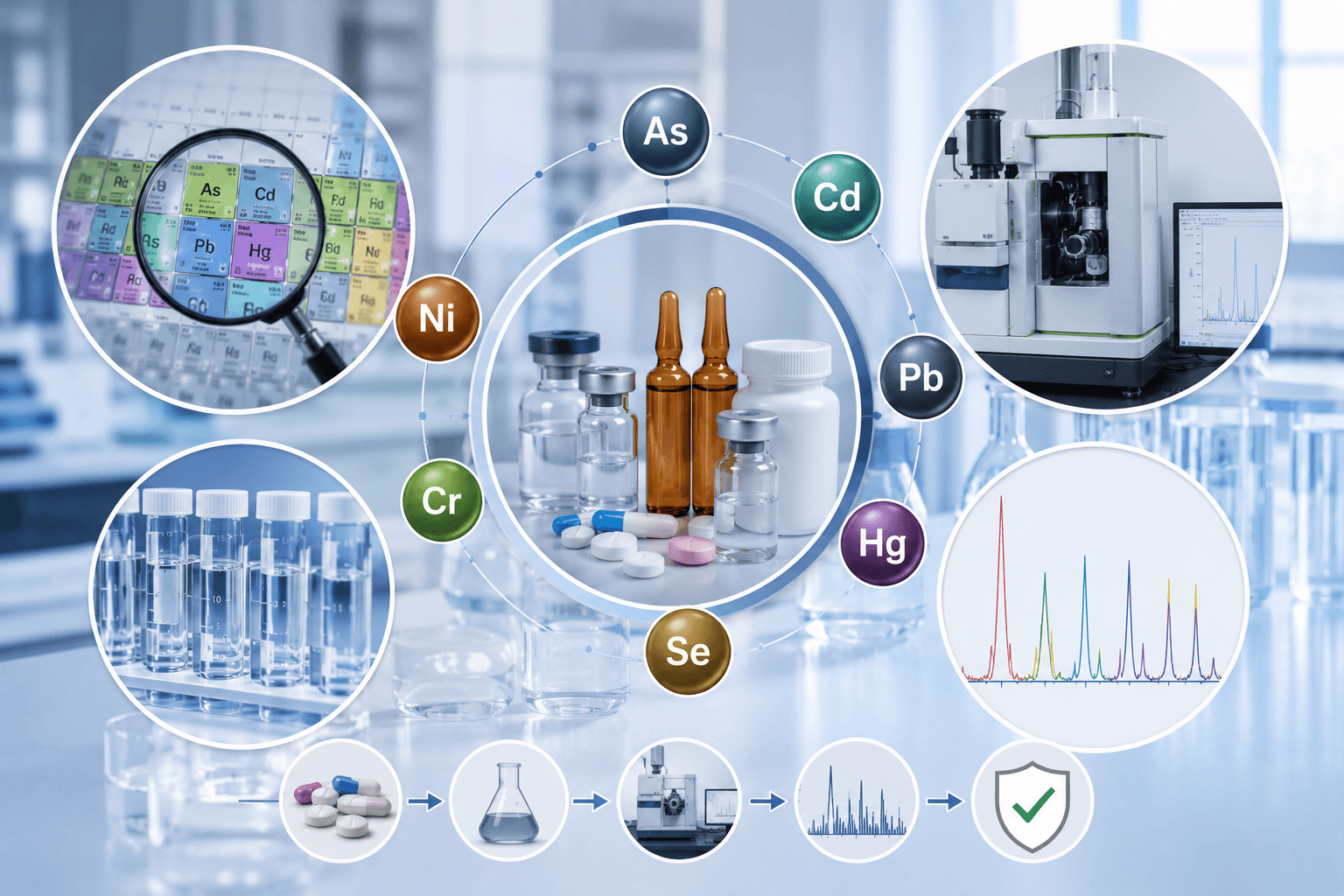
Inductively Coupled Plasma Mass Spectrometry (ICP-MS) has become the preferred technique for elemental impurity analysis due to its exceptional sensitivity, precision, and multi-element detection capability. Advanced analytical capability is essential for generating reliable and reproducible elemental impurity data.
ICP-MS Supports:
- Trace-level metal detection
- Simultaneous multi-element analysis
- Low detection limits
- High analytical accuracy
- Regulatory-compliant reporting
Elements Evaluated Include:
- Arsenic
- Cadmium
- Lead
- Mercury
- Nickel
- Cobalt
- Vanadium
- Palladium
Common Regulatory Challenges
Regulators increasingly expect companies to demonstrate proactive control rather than reactive correction. Common issues include:
- Weak risk assessment methodology
- Lack of scientific justification
- Incomplete supplier evaluation
- Insufficient analytical testing
- Inadequate toxicological interpretation
- Poor documentation practices
- Failure to evaluate worst-case scenarios
- Non-compliant control strategies
Beyond Compliance: Building a Robust Control Strategy
Modern elemental impurity management is not only about meeting regulatory requirements — it is also about protecting product quality, patient safety, and brand integrity. Manufacturers that implement scientifically sound impurity control programs are better positioned to reduce compliance risks and strengthen global market acceptance.
An effective elemental impurity program should include:
- Risk-based evaluation
- Analytical verification
- Supplier qualification
- Process monitoring
- Toxicological assessment
- Ongoing trend analysis
- Change control integration
Advanced Elemental Impurity Testing at Accuprec
At Accuprec Research Labs Pvt. Ltd., we provide comprehensive elemental impurity testing solutions aligned with ICH Q3D expectations and global regulatory standards. Our laboratories operate with advanced instrumentation, experienced scientific teams, and quality-focused systems to ensure reliable and regulator-ready analytical data.
Our capabilities include:
- ICP-MS elemental impurity analysis
- Method development and validation
- Risk assessment support
- Toxicological evaluation
- Raw material assessment
- Finished product testing
- Regulatory documentation support
- Compliance-focused reporting
Supporting Regulatory Readiness
Elemental impurity compliance has become a major focus during regulatory inspections and pharmaceutical product reviews. By combining scientific rigor with regulatory understanding, we help companies strengthen compliance confidence while minimizing approval risks.
Our scientific experts help manufacturers prepare:
- Scientifically justified risk assessments
- Audit-ready documentation
- Analytical study reports
- Regulatory submission data
- Product-specific control strategies
Beyond Paper-Based Assessments: Scientific Evidence Matters
Elemental impurity control under ICH Q3D has evolved far beyond simple paper-based risk assessments. Regulatory authorities now expect manufacturers to support their control strategies with scientifically sound analytical evidence and robust toxicological justification.
Companies that rely solely on theoretical assessments may face increasing regulatory scrutiny, compliance gaps, and approval delays.
Through advanced ICP-MS testing, scientific expertise, and regulator-focused support, Accuprec Research Labs Pvt. Ltd. helps pharmaceutical manufacturers build reliable elemental impurity programs aligned with global compliance expectations.
Partner with Accuprec Research Labs Pvt. Ltd. for comprehensive elemental impurity testing and regulatory support.